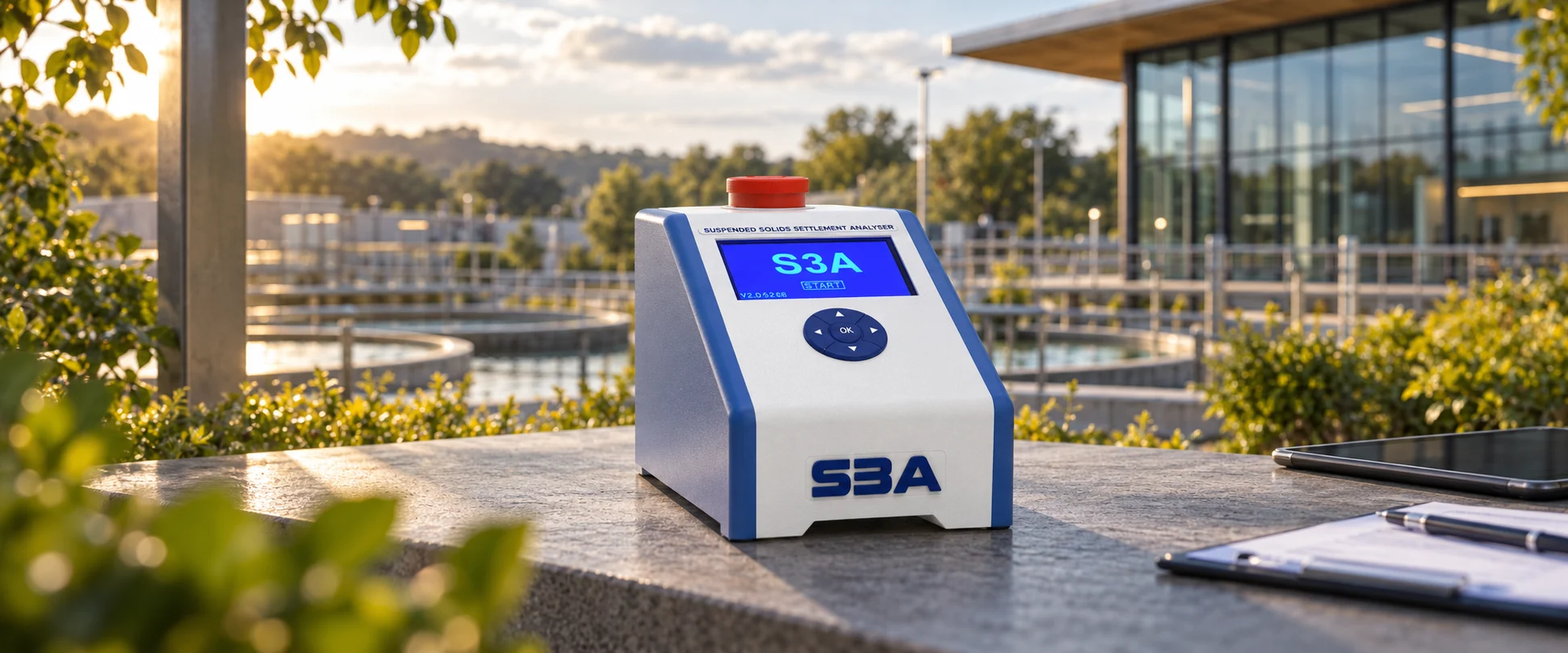
Portable MLSS analysis and settlement testing in one system.
Prepare a representative activated-sludge sample, fill the S3A tube and start the test. The analyser manages the MLSS measurement and settlement cycle, then stores the result at the unit.
01 / MLSS
MLSS from a compact sample
The S3A measures mixed liquor suspended solids from a compact 210 ml sample and provides a result in approximately 10 seconds. The specified MLSS range is 50 to 6,500 mg/L, with stated accuracy of ±10%. Readings above 6,500 mg/L are indicated as INF.
A rapid operational MLSS result
Suitable for mixed liquor and suspended-solids process checks
Specified MLSS accuracy of ±10%
02 / SETTLEMENT TEST
Unattended settlement analysis
After the rapid MLSS result, the S3A continues the 30-minute settlement cycle unattended. It measures settled sludge level, calculates SVI and records supernatant clarity and floating sludge from the same sample.
Automated 30-minute settlement cycle
Supports routine activated-sludge process checks
One sample. Five essential measurements.
Settlement analysis brought together in one instrument
Operators can start the test, continue with other work and return after completion to review automatically calculated results.
210 ml
Compact representative sample
≈10 sec
MLSS measurement
30 min
Unattended settlement test
28
Completed results per location
3
Stored locations
2,000–4,000 mg/L
Known MLSS calibration sample
From sample to useful process information.
Good field data starts with a safe, representative sampling point and a consistent operating technique. The following workflow helps make routine checks comparable.
01.
Collect
Collect a representative mixed-liquor sample from the process point selected by the operator. Return to the same sampling point whenever possible so that changes reflect the process rather than the location.
02.
Prepare
Prepare the 210 ml sample using a consistent sampling method and the site’s operating procedure.
03.
Load
Fill the S3A sample tube and place it in the analyser. Operate indoors in a safe area, away from direct and reflected sunlight.
04.
Start
Start the analysis. The S3A runs the MLSS check and the 30-minute settlement cycle without continuous operator attention.
05.
Review
Review the completed MLSS and settlement outputs alongside the sample identity and site observations.
06.
Store
Store the completed result against the selected location. The unit retains 28 results for each of three locations, with date and time.
Seven measurements, with stirred tests clearly identified.
MLSS
Mixed Liquor Suspended Solids
50 to 6,500 mg/L specified range with stated accuracy of ±10%.
mg/L · approximately 10 seconds
SVI
Sludge Volume Index
Relates settled sludge volume to MLSS concentration.
mL/g · 30 minutes
SSL
Settled Sludge Level
Settled-sludge volume measured after the settlement period.
mL/L · 30 minutes
SPNT
Supernatant clarity
Operational indication of solids remaining above the settled sludge.
mg/L · 30 minutes
FS
Floating sludge
Indication of sludge floating or rising after settlement.
mm · 30 minutes
SSVI
Stirred Sludge Volume Index
Available only with the optional stirrer module.
mL/g · 30 minutes
SSSL
Stirred Settled Sludge Level
Available only with the optional stirrer module.
30 minutes
Optional MODBUS RTU connectivity.
Bring supported S3A readings into a compatible client system using optional MODBUS RTU over two-wire RS-485. Specify the option when ordering and confirm the required data with PMA. Dashboard and network integration are configured by the client.
RS-485
Two-wire connection for compatible client systems.
MODBUS RTU
Optional communication interface; specify when ordering.
03 / 04
Supported MODBUS read functions.
Client system
Dashboards and network integration are client-provided.
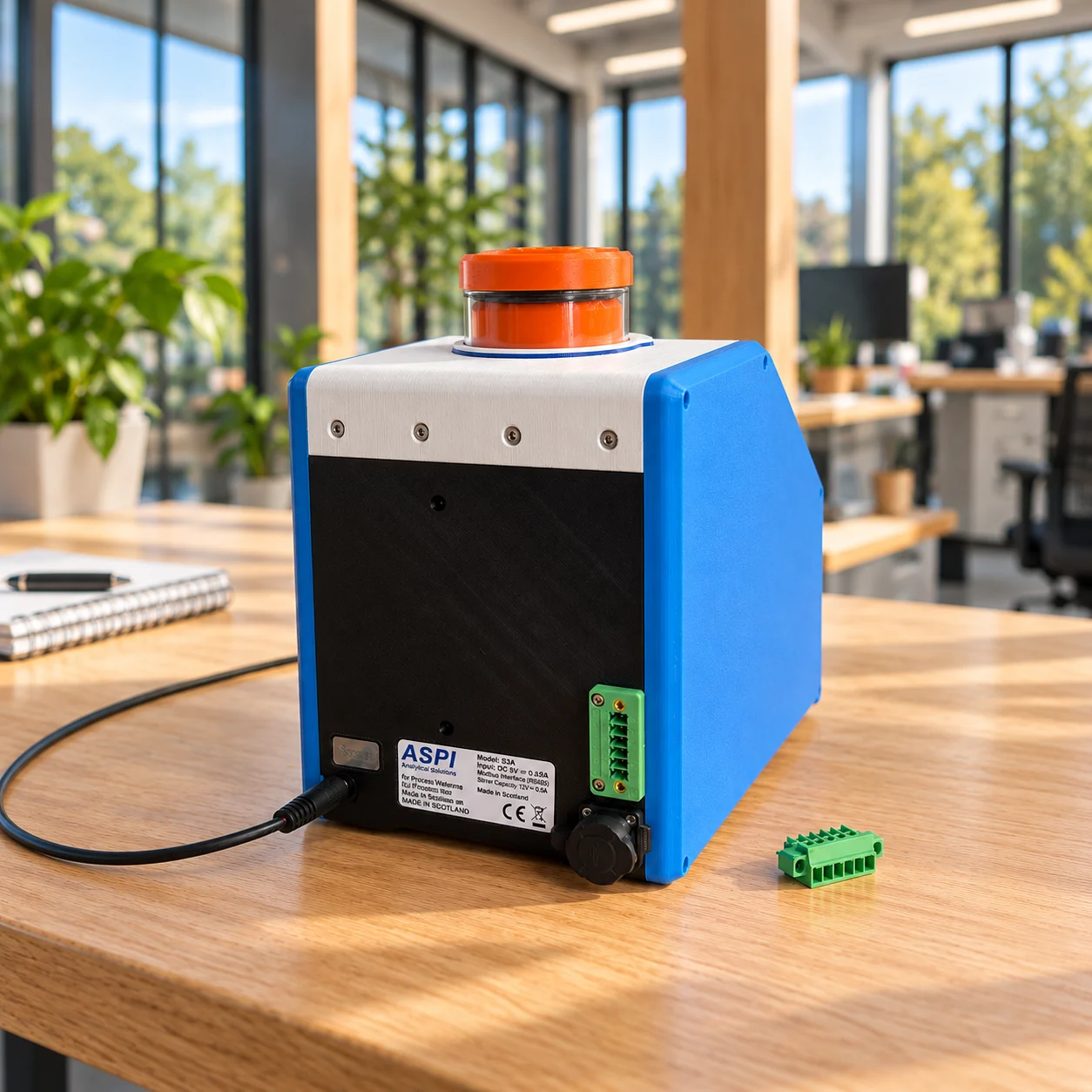
Function 06 is limited to Holding Register 40001 for the slave ID (1–247). It does not write measurement values or control tests. Dashboards and network integration are provided by the client.
Built around the realities of routine operator testing
01
Automated and efficient
Reduces the manual workload associated with timing, recording and calculating results.
02
Compact sample volume
Uses a 210 ml sample, reducing the need to handle a larger bucket of mixed liquor.
03
Unattended test cycle
The 30-minute test runs without the operator remaining beside the instrument.
04
Consistent results
Provides an instrument-led routine with stated MLSS accuracy of ±10%.
05
Simple operation
Uses push buttons and a backlit LCD display.
06
Result storage
Stores up to 28 completed results for each of three locations, with time and date information.
07
Compact footprint
Designed for laboratory and operational environments.
08
Site-specific calibration
Use a sample with known MLSS between 2,000 and 4,000 mg/L. Repeat after large changes in sludge characteristics.
09
Optional stirred tests
The optional stirrer module enables SSVI and SSSL testing.
Technical specifications.
Core S3A information for specification and application review.
| MLSS range | 50–6,500 mg/L; above 6,500 mg/L is indicated as INF |
|---|---|
| MLSS result | Approximately 10 seconds |
| Settlement cycle | 30 minutes |
| Sample volume | 210 ml |
| Measured parameters | MLSS, SSL, SVI, supernatant clarity and floating sludge |
| Optional stirrer | SSVI and SSSL |
| Data storage | 28 results for each of three locations |
| Calibration | Known site-specific MLSS sample of 2,000–4,000 mg/L; repeat after large sludge changes |
| Optional connectivity | MODBUS RTU, two-wire RS-485; read functions 03/04. Write function 06 is limited to Holding Register 40001 (slave ID, 1–247); it does not write measurement values or control tests. Specify when ordering; client integration required. |
| Operating environment | Indoor, safe area; 0–45°C, noncondensing. Keep out of direct and reflected sunlight. |
Specifications are based on the current PMA S3A brochure and may be subject to product development. Confirm critical requirements with PMA before specification.
How to interpret suspended solids analyser readings.
Review concentration and settlement results together and against site observations. The TSS vs MLSS guide explains the terminology boundary, while the measurement hierarchy covers each S3A result. For industrial activated-sludge sites, see the industrial effluent treatment application before checking S3A suitability with PMA.
Activated-sludge process monitoring
Compare MLSS, settlement and SVI results over time alongside site observations. The S3A tests a collected sample; it is not an in-tank blanket-depth monitor.
TSS vs MLSS
Compare TSS and MLSS terminology, sample context and analyser roles, then see where the portable S3A fits activated-sludge operational checks.
Explore guideMeasurement parameters
Explore the S3A measurement parameters for activated sludge, including MLSS, SVI, settled sludge level, supernatant clarity and floating sludge.
Explore guideIndustrial effluent
See where the S3A supports MLSS and sludge-settlement checks in industrial activated-sludge treatment, and what to confirm before use.
Explore applicationAeration basins
MLSS readings support routine activated-sludge process checks and comparison between lanes or operating periods.
Sequencing batch reactors
Compare MLSS and settlement results through the site’s established SBR sampling routine, with process context recorded alongside each test.
Return activated sludge
Review return-stream concentration and settlement checks within the instrument range, keeping sample identity and operating context with the result.
Operational analyser, not a replacement for required laboratory analysis.
S3A supports operational checks of activated sludge. Compliance sampling, regulatory testing and required laboratory analysis should still follow the procedures that apply to the site.
What is Sludge Volume Index?
SVI considers both MLSS concentration and the volume occupied by sludge after settlement. It is normally expressed in mL/g.
A general reference range
Approximately 50 to 150 mL/g is often associated with satisfactory settlement, but process context and trends matter.
Higher SVI
Generally indicates slower settlement. The underlying cause requires further process investigation.
Very low SVI
May be associated with rapidly settling sludge or pin floc. SVI should not be interpreted in isolation.