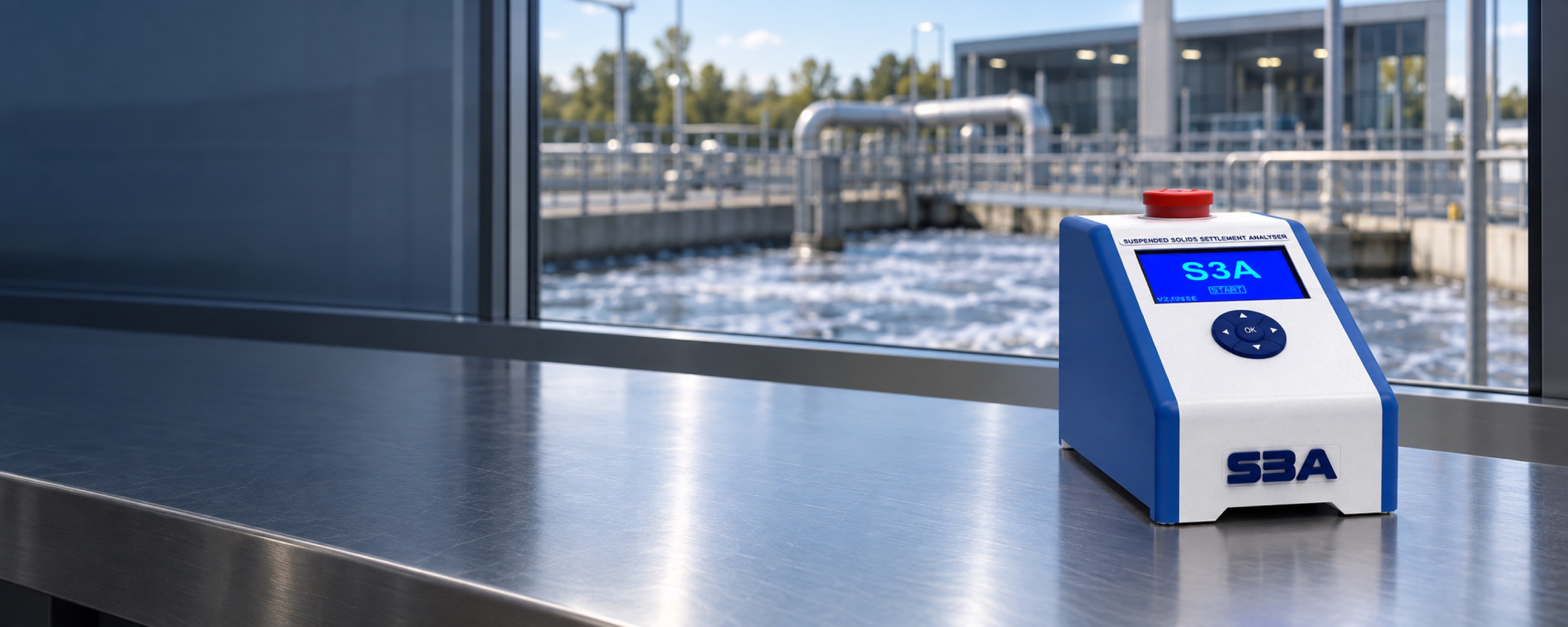
Connect the biological stage to meaningful measurements.
Industrial effluent may vary with production, cleaning and operating cycles. If a site uses an activated-sludge stage, MLSS and settlement checks can add operational context to its established sampling and laboratory programme.
MLSS
Check mixed-liquor concentration
Settlement
Follow SVI and settled sludge level
Separation
Review clarity and floating sludge
Build a site-specific monitoring route.
Agree when and where samples are taken, and record the process conditions. The S3A supports comparison of representative samples; it does not identify a discharge problem from one reading.
Choose the biological-stage sample
Select a safe point representing the mixed liquor under review. Keep the point and timing consistent, especially when production cycles change loading.
Check the expected solids range
Confirm the sample falls within the S3A specified MLSS range of 50–6,500 mg/L and stated accuracy of ±10%. Ask PMA about unusual or variable sample conditions.
Keep method and context together
Use the same sample preparation and note whether SVI is unstirred or optional stirred SSVI. Record relevant process changes when comparing results.
One sample, concentration then settlement.
The S3A uses a representative 210 ml sample. MLSS is available in approximately 10 seconds; the settlement cycle continues for 30 minutes.
01 / Begin with MLSS
Start with an MLSS check
Compare the concentration result with the site’s established operating range and relevant laboratory and process records.
02 / Complete settlement
Review the completed settlement result
SVI, settled sludge level, supernatant clarity and floating sludge help describe how the sampled mixed liquor behaves during the test.
Use the result within the plant’s operating plan.
The S3A can be considered for safe-area operational checks at industrial plants with biological treatment, including conventional activated sludge, SBR or MBR processes, provided samples meet the instrument specification.
It is not an online discharge monitor and does not measure COD, BOD or final-effluent compliance. Keep required regulatory sampling and accredited analysis in place.
Explore the connected S3A routes.
Continue to the food-and-beverage branch, the activated-sludge monitoring guide, or the product specification to assess technical fit.
Food and beverage wastewater
See the broader production-site context and routes for breweries and distilleries.
Activated-sludge monitoring
Follow the core sample-to-result workflow for biological treatment.
S3A product details
Check measurement range, test cycle, limitations and support before specifying the instrument.