Online instrumentation can provide continuous process data, but settlement testing offers something different. It allows engineers to observe how activated sludge separates, compacts and behaves under controlled conditions.
When the test is carried out consistently, it can help identify changes in:
Mixed liquor suspended solids
Sludge settleability
Settled sludge volume
Supernatant clarity
Floating or rising sludge
These measurements provide useful evidence of changing upstream biological conditions before they develop into more serious operational problems.
What Is the 30-Minute Sludge Settlement Test?
The 30-minute sludge settlement test measures how a representative activated-sludge sample settles when left for a defined period.
In a traditional manual test, mixed liquor is collected from the aeration process and transferred into a graduated settlement cylinder or jar. The sample is then allowed to settle for 30 minutes.
At the end of the test, the operator normally records the settled sludge volume and assesses the condition of the liquid above the sludge.
The main measurements associated with settlement analysis include:
Mixed Liquor Suspended Solids, or MLSS
Settled Sludge Level, or SSL
Sludge Volume Index, or SVI
Supernatant clarity
Floating sludge
These results should be reviewed together rather than treated as isolated measurements.
Why Is Sludge Settlement Important?
The activated-sludge process depends on microorganisms forming floc that can separate effectively from treated wastewater.
When sludge settles and compacts consistently, biological solids can be retained within the treatment process and returned or removed according to the operating strategy.
When settlement deteriorates, the final settlement stage may become more difficult to manage.
Poor or changing settlement behaviour can be associated with:
Slow-settling or bulking sludge
Unstable sludge blankets
Solids approaching or passing over clarifier weirs
Reduced clarification capacity
Floating sludge
Pin floc or dispersed solids
Changes in sludge age
Increased operator intervention
Greater final-effluent risk
The settlement test cannot determine the root cause of a process problem by itself. It provides evidence that conditions may be changing and that further investigation is required.
Stable upstream settlement and MLSS control can help reduce downstream risk, but settlement testing does not replace final-effluent monitoring or required laboratory analysis.
Which Measurements Should Engineers Review?
Mixed Liquor Suspended Solids
Mixed Liquor Suspended Solids, usually shortened to MLSS, represents the concentration of suspended solids within the mixed liquor.
MLSS is normally reported in milligrams per litre and is a core measurement used in activated-sludge process control.
It helps operators understand the concentration of biomass and other suspended material within the aeration process.
A single MLSS result offers limited information. Engineers should compare the result with the site's normal operating range and review changes over time.
A rising or falling MLSS concentration may reflect changes in:
Solids retention
Sludge wasting
Return activated sludge flow
Hydraulic loading
Biological growth
Process operating conditions
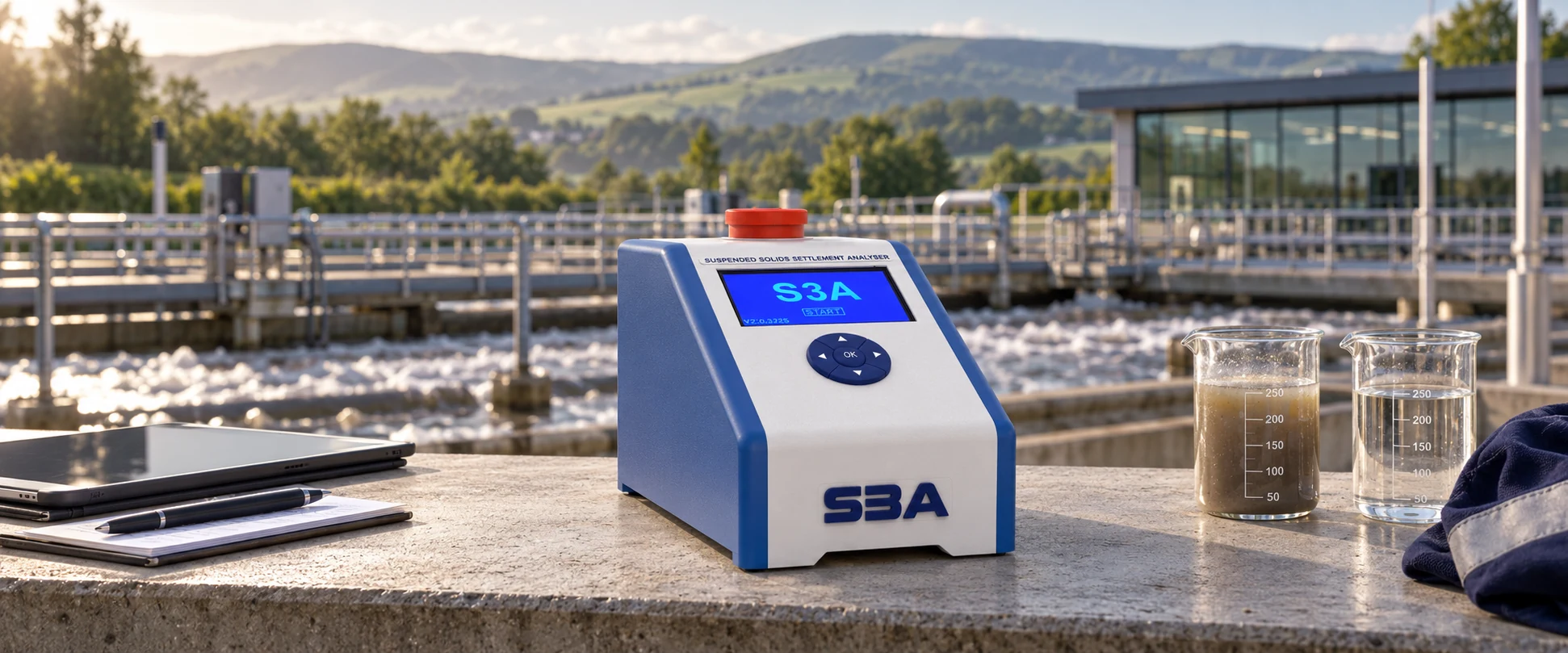
The S3A Suspended Solids Settlement Analyser measures MLSS from a compact 210 ml sample in approximately 10 seconds.
Settled Sludge Level
Settled Sludge Level, or SSL, describes the volume occupied by the sludge after the defined settlement period.
Recording the settled sludge level after 30 minutes helps operators compare how compactly different mixed-liquor samples settle.
Changes in the settled sludge level may indicate changes in:
Floc structure
Sludge settleability
Solids concentration
Biological conditions
Process loading
SSL should always be interpreted alongside MLSS.
Two samples may occupy a similar volume after settling while containing different concentrations of suspended solids.
Sludge Volume Index
Sludge Volume Index, or SVI, relates the volume occupied by settled sludge to the MLSS concentration.
It is normally expressed in millilitres per gram.
SVI is widely used to compare activated-sludge settleability over time. A higher SVI generally indicates that the sludge occupies more volume for each gram of suspended solids and is settling or compacting less effectively.
An approximate range of 50 to 150 mL/g is often associated with satisfactory settlement. However, this is only a general reference range.
The expected SVI depends on:
The treatment process
Plant design
Influent characteristics
Sludge age
Loading conditions
Site-specific operating experience
A change away from the site's established SVI trend is often more useful than comparing one result against a generic target.
Supernatant Clarity
The liquid remaining above the settled sludge is known as the supernatant.
Its clarity provides an additional indication of how effectively suspended material has separated during the settlement test.
A visibly cloudy supernatant may indicate:
Fine suspended solids
Small floc particles
Dispersed biological material
Poor floc formation
Incomplete solids separation
A compact settled sludge layer does not necessarily mean that the liquid above it is clear.
This is why supernatant clarity should be assessed alongside SVI, SSL and MLSS.
Floating Sludge
Sludge that rises or floats after settling may provide evidence of gas formation within the settled solids.
One possible cause is denitrification. Nitrogen gas can become trapped within the sludge and carry solids towards the surface.
Floating sludge can have other causes, so the observation should trigger further investigation rather than an immediate conclusion.
Recording floating-sludge behaviour as part of the routine test provides another useful point of comparison between:
Different samples
Treatment lanes
Operator shifts
Wastewater treatment sites
Changing operating conditions
How Is Sludge Volume Index Calculated?
SVI is calculated using the settled sludge volume after 30 minutes and the MLSS concentration from the same sample.
SVI (mL/g) = settled sludge volume after 30 minutes (mL/L) ÷ MLSS concentration (g/L)
For example, consider a mixed-liquor sample with:
Settled sludge volume of 300 mL/L
MLSS concentration of 3,000 mg/L
The MLSS concentration must first be converted from milligrams per litre to grams per litre.
3,000 mg/L is equal to 3 g/L.
The SVI calculation is therefore:
300 ÷ 3 = 100 mL/g
The calculated Sludge Volume Index is 100 mL/g.
Care is needed when recording the units. Using milligrams per litre instead of grams per litre will produce an incorrect result.
What Causes a High Sludge Volume Index?
A rising SVI generally indicates that the sludge is occupying more volume and settling or compacting less effectively.
However, SVI cannot identify the cause by itself.
Possible causes of a high or increasing SVI include:
Filamentous organism growth
Low dissolved oxygen
Changes in organic loading
Nutrient imbalance
Changes in sludge age
Hydraulic surges
Industrial or chemical shock loads
Temperature changes
Changes in return activated sludge control
Changes in waste activated sludge rates
When SVI changes significantly, engineers should review the result alongside wider process information.
Further investigation may include:
Microscopic examination
Dissolved oxygen profiling
Sludge-age calculations
Nutrient checks
Influent loading assessment
Return sludge review
Waste sludge review
Examination of recent process trends
The important point is that SVI is an indicator. It helps identify that the process is changing, but it does not diagnose the cause on its own.
What Causes a Very Low SVI?
A very low SVI normally indicates rapid settling and compact sludge.
Although this may initially appear desirable, a very low SVI is not automatically evidence of ideal process conditions.
Very rapid settlement can sometimes be associated with:
Small dense floc
Pin floc
Old sludge
Fine suspended biological material
Poor capture of small solids
Fine particles may remain suspended in the supernatant even when the main sludge layer settles quickly.
A low SVI combined with cloudy supernatant should therefore be investigated rather than assumed to represent good settlement.
What Are the Limitations of Manual Settlement Testing?
The traditional manual settlement test is straightforward, but its quality depends heavily on consistent operator technique.
Common practical limitations include:
Collecting and carrying a large mixed-liquor sample
Using different sampling points
Inconsistent sample mixing
Starting the timer at different stages
Returning late to read the result
Differences in identifying the sludge interface
Manual calculation errors
Incomplete result recording
Variation between operators and shifts
If an operator is called away during the test, the result may be read late or the entire test may need to be repeated.
These variations make it more difficult to compare results between different operators, shifts and treatment sites.
The manual method remains useful, but consistent sampling, timing, calculation and result recording are essential.
How Can the 30-Minute Settlement Test Be Automated?
The S3A Suspended Solids Settlement Analyser automates routine activated-sludge settlement analysis using a compact 210 ml sample.
From one sample, the S3A measures:
Mixed Liquor Suspended Solids
Sludge Volume Index
Settled Sludge Level
Supernatant clarity
Floating sludge
The MLSS result is produced in approximately 10 seconds.
The analyser then completes the 30-minute settlement cycle unattended, allowing the operator to continue with other operational or consent-critical work.
Results can be stored after the test has completed, including date, time and sample-location information.
The S3A stores up to 28 completed results for each of three locations, helping operators compare measurements over time.
The specified MLSS measurement range is 50 to 6,500 mg/L, with stated accuracy of ±10%.
You can review the analyser's measurements, workflow and operating specifications on the S3A product page.
What Is the Difference Between SVI and SSVI?
SVI is normally measured using an unstirred sample.
SSVI means Stirred Sludge Volume Index. During an SSVI test, the sample is kept under controlled, gentle movement throughout the settlement period.
A stirred test can help reduce some of the wall effects associated with an unstirred settlement vessel.
Stirred settlement analysis is commonly used within UK wastewater-treatment practice.
SVI and SSVI are not interchangeable results. Engineers comparing historical data must ensure that the same test method has been used each time.
The optional S3A stirrer extends the measurement capability to include:
Stirred Sludge Volume Index
Stirred Settled Sludge Level
The optional stirrer should be specified where the site's routine operating procedure requires SSVI or SSSL.
How Can Wastewater Treatment Sites Improve Test Repeatability?
Whether settlement testing is manual or automated, representative sampling and consistent technique remain essential.
Use the Same Sampling Point
Collect mixed-liquor samples from a safe and representative process location.
Returning to the same sampling point helps ensure that changes in the results reflect process behaviour rather than differences between sampling positions.
Collect a Representative Sample
The sample should accurately represent the process being assessed.
Avoid collecting only:
Surface liquid
Material from a stagnant area
Settled solids
Foam
An unrepresentative grab sample
Use a Consistent Test Method
Use the same:
Sample volume
Sampling point
Sample preparation method
Test duration
Result-recording procedure
Clearly identify whether the result was produced using an unstirred SVI test or a stirred SSVI test.
Record Results After the Test Has Completed
Record the:
Sampling location
Date
Time
MLSS
Settled sludge level
SVI or SSVI
Supernatant clarity
Floating-sludge observation
Relevant process conditions
Results should be stored after the complete test cycle has finished.
Review Trends Rather Than Individual Results
A single settlement result is only a snapshot.
A consistent series of results is more useful for identifying:
Gradual deterioration
Sudden process shocks
Changes between treatment lanes
Differences between sites
Recurring operating patterns
The effect of corrective action
Where Can the S3A Be Used?
The S3A is designed for routine activated-sludge process checks within safe-area wastewater-treatment environments.
Potential wastewater applications include:
Conventional activated-sludge treatment works
Sequencing Batch Reactors
Membrane Bioreactors
Anammox processes within the stated MLSS range
Wastewater-treatment laboratories
Operational testing close to the treatment process
The analyser is not:
A continuous online analyser
A SCADA-connected instrument
A hazardous-area device
A final-effluent monitor
A replacement for statutory compliance sampling
Compliance testing, laboratory analysis and required final-effluent monitoring should continue according to the procedures applicable to the individual wastewater treatment works.
How Does Settlement Analysis Support Process Control?
Settlement analysis forms one part of a wider wastewater process-monitoring programme.
The results should be reviewed alongside measurements such as:
Dissolved oxygen
Ammonia
Nitrate
Sludge age
Return activated sludge flow
Waste activated sludge flow
Influent loading
Final-effluent suspended solids
Sludge blanket level
Consistent upstream measurement helps operators understand whether the biological process is stable and whether settlement behaviour is moving away from established operating conditions.
PMA Ltd supplies and supports water and wastewater instrumentation throughout the UK, including equipment for process control, portable testing and compliance monitoring.
Engineers looking for wider portable water and wastewater measurement options can also visit Portable Analyser.
For portable sludge blanket, interface-depth and suspended-solids measurement equipment, visit Portable Sludge Meter.
Should You Automate Your Sludge Settlement Testing?
Automation may be worth considering where:
Settlement tests are performed regularly
Operator time is limited
Tests are sometimes read late
Manual calculations create inconsistencies
Results need to be compared across shifts
Multiple sample locations are monitored
Consistent records are required
The main benefit is not simply replacing a settlement cylinder.
Automation creates a repeatable workflow for:
Sample testing
Settlement monitoring
SVI calculation
MLSS measurement
Floating-sludge detection
Completed-result storage
The S3A allows the operator to begin the test and continue with other work while the 30-minute settlement cycle runs unattended.
For help assessing whether the instrument is appropriate for your process, visit S3A support or contact PMA.