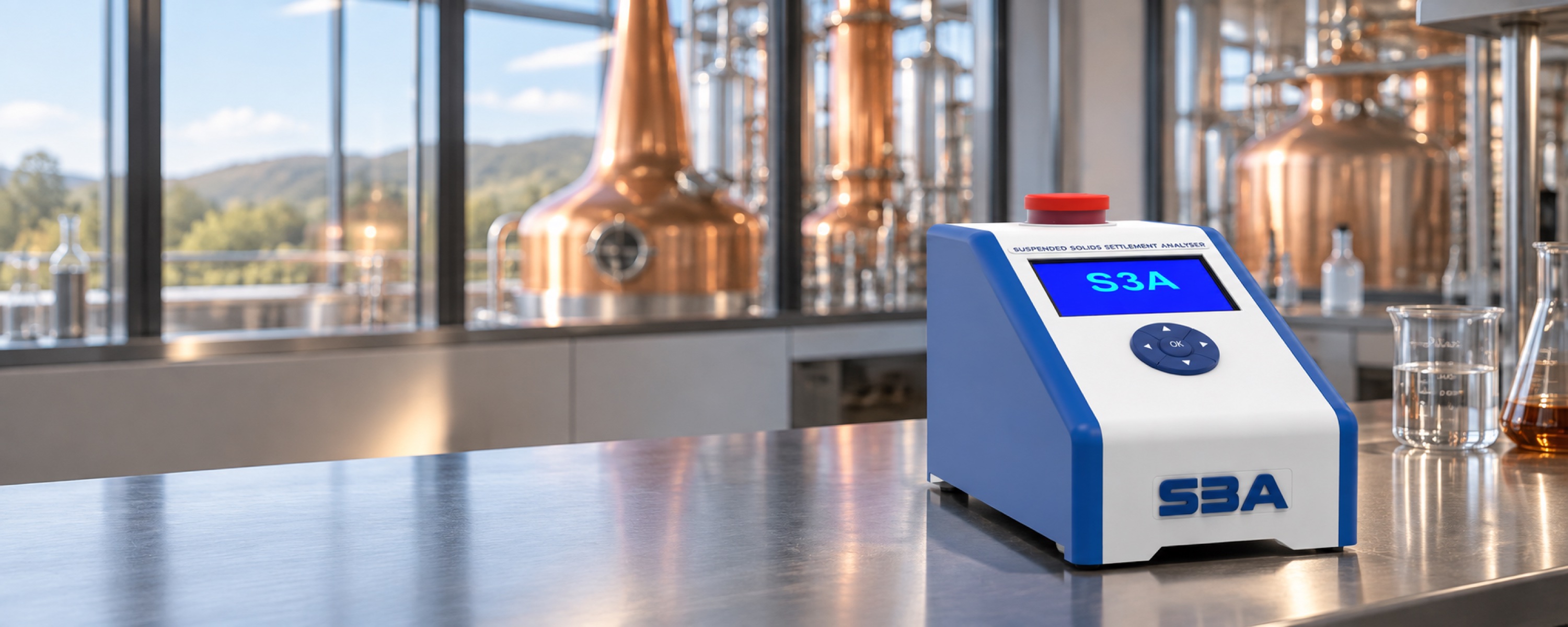
Focus on the biological treatment stage.
Distillery operations can generate wastewater from production and cleaning. Treatment arrangements differ by site; where activated sludge is used, a consistent MLSS and settlement routine can help operators understand the sampled biological process.
MLSS
Check mixed-liquor concentration
SVI
Compare sludge settleability
Separation
Observe clarity and floating sludge
Make the sample repeatable.
Identify the biological-stage location and process phase being assessed. Record relevant operating context so a change in one test is not mistaken for a complete diagnosis.
Use a safe sample point
Collect representative mixed liquor from an approved safe location. The S3A is not specified for use in hazardous production areas.
Check the sample range
The stated S3A MLSS range is 50–6,500 mg/L at ±10% accuracy. Confirm anticipated high or unusual solids conditions before adopting the routine.
Record production context
Note timing of production or cleaning cycles and use a consistent unstirred SVI or optional stirred SSVI method for trend comparisons.
One sample; two stages of insight.
A representative 210 ml sample produces an MLSS result in approximately 10 seconds, followed by a 30-minute settlement cycle.
01 / Begin with MLSS
Start with MLSS
Compare the concentration with the site’s normal biological-treatment operating range and any relevant process records.
02 / Complete settlement
Then inspect settlement
Review SVI, settled sludge level, supernatant clarity and floating sludge together to describe how that sample settled.
Keep operational and compliance roles separate.
The S3A may support routine process checks where distillery wastewater receives activated-sludge treatment and the sample fits its specification. It does not establish that a particular distillery uses this process or that a specific intervention is needed.
It is not a COD/BOD instrument, online discharge monitor or substitute for permit sampling and laboratory analysis. PMA can review the site’s treatment configuration before recommending a monitoring route.
Continue through related routes.
Compare the food-and-beverage overview with a brewery application and the full S3A parameter explanation.
Food and beverage
Return to the broader biological-treatment monitoring overview.
Brewery effluent
See how the same S3A measurements fit another beverage-treatment context.
S3A measurements
Review MLSS, SVI, SSL and the other core and optional outputs.