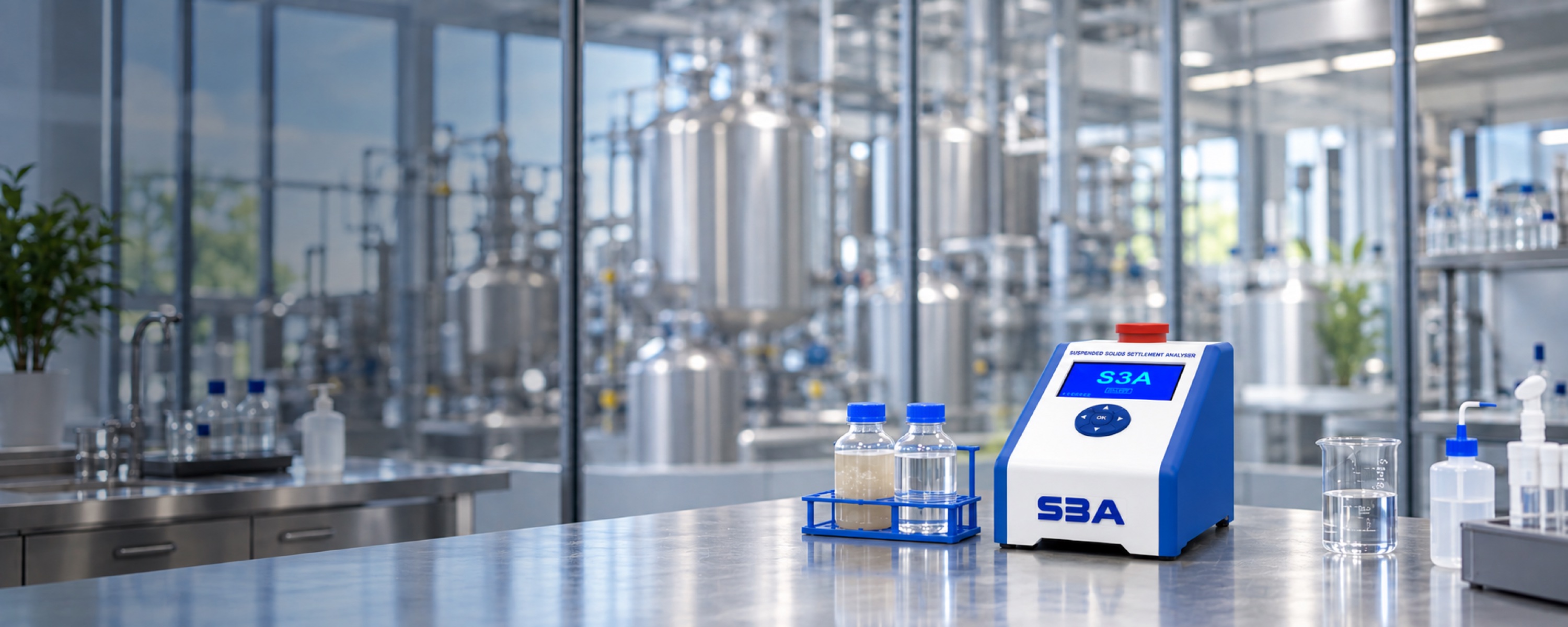
Monitor the treatment stage, not the production line.
Product changeovers, cleaning and variable throughput can alter the wastewater entering a treatment plant. The S3A is for representative samples from the biological treatment stage, where its concentration and settlement measurements fit the site’s operating method.
MLSS
A rapid concentration check
SVI
Observe sludge settleability
Separation
Review clarity and floating sludge
Set up a repeatable monitoring routine.
A useful result starts with a safe, representative sample and a consistent comparison point. Align the test with site records, process observations and required laboratory checks.
Sample the right stage
Select the mixed-liquor point that represents the biological process being assessed. Do not treat a raw influent or final discharge result as an S3A MLSS reading.
Confirm technical fit
Check the expected mixed-liquor concentration against the specified S3A range of 50–6,500 mg/L, with stated accuracy of ±10%. Confirm unusual samples with PMA.
Compare coisas semelhantes.
Use a consistent sampling time and method when production or cleaning cycles vary. Distinguish unstirred SVI from optional stirred SSVI.
A connected result from one sample.
The S3A uses a 210 ml sample, provides MLSS in approximately 10 seconds and follows the 30-minute sludge-settlement cycle.
01 / Begin with MLSS
Check biological-stage MLSS
Review the result beside the site’s operating range, loading context and other process measurements rather than using it alone as a control instruction.
02 / Complete settlement
Complete the settlement picture
The instrument reports SVI, settled sludge level, supernatant clarity and floating sludge from the sample. These describe settling behaviour, not permit compliance.
Choose the most relevant industry route.
The same measurement principles can be relevant to breweries, distilleries and other food or beverage sites with suitable activated-sludge treatment. The treatment configuration and sample range, not the industry label alone, determine fit.
Use the S3A in a safe area. It is not an online analyser and does not replace COD, BOD, final-effluent TSS or required laboratory and regulatory testing.
Explore industry-specific applications.
Go deeper into distillery and brewery treatment, or compare the wider industrial effluent monitoring route.
Distillery wastewater
Consider MLSS and sludge settlement where distillery effluent receives activated-sludge treatment.
Brewery effluent
Review a repeatable MLSS and SVI route for brewery biological treatment.
Industrial effluent
See the broader activated-sludge application principles and technical limits.